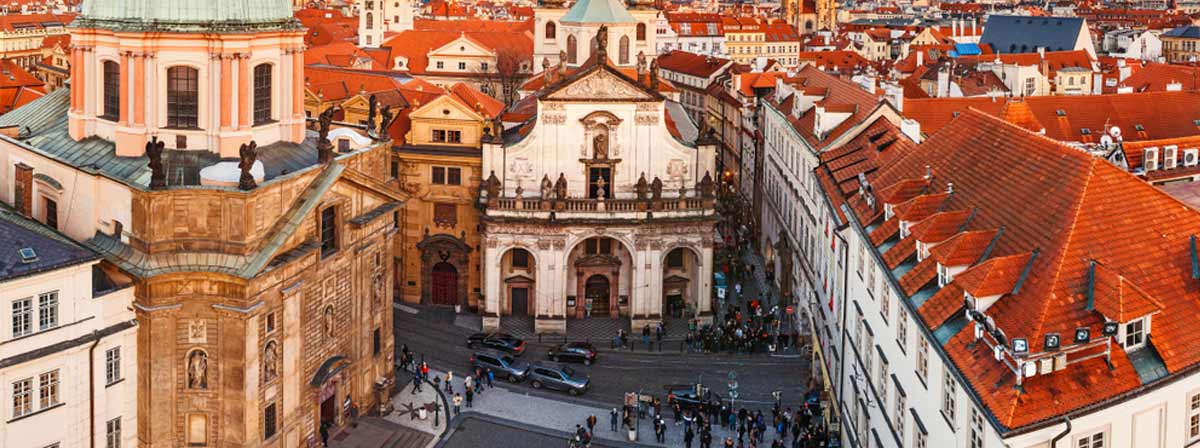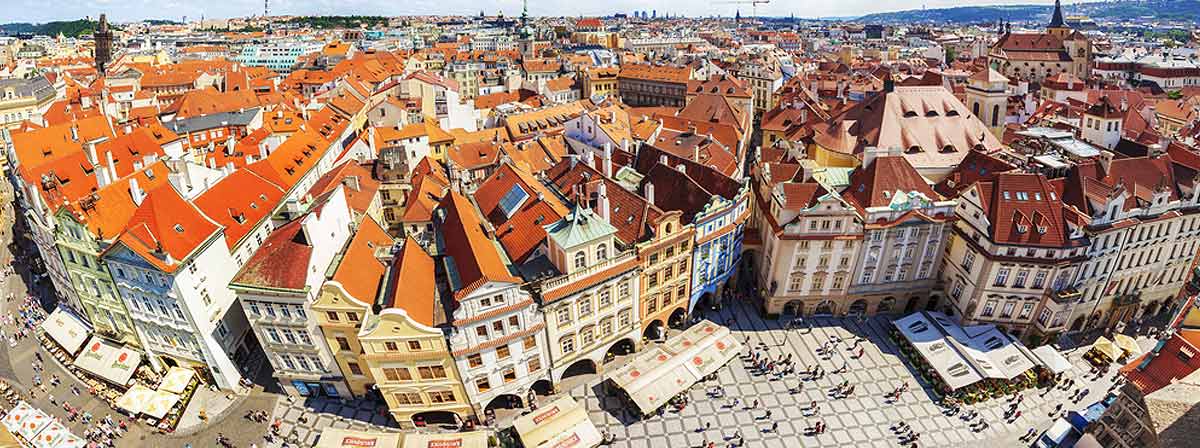
Considering that Bohemia is the border between Eastern and Central Europe you get the best of both world. High quality of life and affordable prices. Outside of Prague cost of living in Czech Republic is surprisingly low.
A residency permit will enable you to buy property in the Czech Republic. These are the steps you need to take:
Apply to the property register for transfer of title. (This usually takes about three weeks.) It takes an average of 24 days to complete all three procedures needed to register a property in the Czech Republic, though procedures are now faster than they were in the past.
The costs come to around 6.7-9.21% of the purchase price. Prices range from for a one-bedroom house in Prague around 5 077 870 CZK (£149 792) to 100 000 000 CZK (£2 949 900) for a beautiful 4-story renovated apartment. This website will give you some idea of prices — and they will be cheaper in rural areas: Prague Real Estate.
You can live and work in the Czech Republic without a visa or work permit. That’s thanks to The European Free Movement of Workers agreement. Your ability to find work depends upon your language skills. English is a bonus, but it helps to be fairly fluent in Czech. If you are moving for employment, the administrative details may be handled by the employer. It is wise to get a written contract if possible. A verbal contract gives little protection. Your employer has to complete a form reporting your presence to the relevant regional office of the Public Employment Service. You can find samples of various forms, most of which will be irrelevant to you, at the Czech Foreign Employment Centre.
If you are a pensioner, you need to inform the IPC (International Pension Centre) to prevent problems with your pension payments (tel: 0191 218 7777). The Czech Republic has double taxation agreements with the UK so you will not be taxed twice, provided you ensure that the tax offices are aware of your circumstances. You can arrange to have your pension paid directly into your Czech bank account. This way you still benefit from the increases as if you still lived in Britain. Contact HMRC and your pension providers well before you leave the UK. If you’ve only worked, lived or are working abroad then you must claim the state pension through the relevant authority of the country where you currently live and have worked in.
Although Britain is not a member of the Schengen area, and therefore customs formalities apply, because we are members of the EU, there is little of consequence to concern the average Briton relocating to the Czech Republic.
Currency — there are no restrictions. Free import of goods bought from the EU with some restrictions on the amount of alcohol and cigarettes. Medicines for personal use only.
Pets require their own pet passport, microchips, rabies vaccinations within 1 year, but not closer than 21 days from departure, and up-to-date routine vaccinations. For more detailed information contact the Czech embassy or visit the Czech Veterinary Administration website. If you intend to bring the pet back to the UK you must ensure the rabies vaccinations are kept up to date.
As a citizen of the EU, British people do not require a visa or residency permit to move to the Czech Republic. However, a residency permit is useful in a variety of ways e.g. applying for a driving licence, buying a house. You must register your presence within 2 days of entering the country to the local Foreign Police Department; if you don’t speak Czech take someone with you who does if you can.
The temporary permit lasts for 5 years and after that you can apply for a permanent residency permit. You will need two passport type photographs, ID, work permit or similar, health insurance certificate and proof that you can support yourself. Family members will need marriage or birth certificates. The process usually takes around 2 months to complete. If you want to receive post, make sure that your name is on the post box where you live.
Czech is the official language in the Czech Republic. This is a Slavonic language like Slovak, Polish, Serbian, Russian, Croatian and Bulgarian. Although the alphabet used is the Latin one, they use lots of diacritical marks (accents), making one letter for one sound — and their marks can change the meaning and pronunciation of words You will find that in Prague many people do speak English, and German, but not in country districts. However, the Czechs do seem to be both kind and patient. Learn a little Czech and it should go a long way.
You need to get a form S1 to prove you have full National Health Insurance in the UK. otherwise you will need to arrange private health insurance when you arrive.
Contact the Overseas Healthcare Team Tyneview Park, Whitley Bay Road, Newcastle upon Tyne NE98 1BA (Tel: 0191 218 1999)The level of care is excellent – but you must have insurance to pay for it, either public health insurance or private. Your employer will pay part of this. You will need to show your insurance card every time you visit the doctor. The GOV.UK site is a good source of information, which also tells you about your pension rights if you are retiring there.
The European Free Movement of Workers agreement means you can live and work in the Czech Republic without a visa or work permit. Your ability to find work depends upon your language skills. English is a bonus, but it helps to be fairly fluent in Czech. If you are moving for employment, the administrative details may be handled by the employer. It is wise to get a written contract if possible. A verbal contract gives little protection. Your employer has to complete a form reporting your presence to the relevant regional office of the Public Employment Service. You can find samples of various forms, most of which will be irrelevant to you, at the Czech Foreign Employment Centre.
Prague has one of the best public transportation systems in Europe. In Prague the main operator is the DPP which operates the metro, trams, buses, the funicular railway and the chairlift at the zoo. The transport is efficient, frequent, clean and safe. It is also logical with a clear signing system and onboard displays — very reassuring for the traveller new to the area. They are also not too expansive, yet. While the trams tend to serve the inner city area, the outlying areas are served mainly by bus. The newer trams have low boarding, and are easy to use for pushchairs and wheelchairs. There are a variety of ticket types.
Opencards or the more flexible transferable pass (which other people can use) are available to all, but require a Czech address. For this you apply at the town hall, with two copies of the application form, photo, ID and a proof of a Czech address and the fee. If you are over 70 years old, irrespective of nationality you can obtain a PID card from many metro stations — and then you can travel free. You need one passport-style photo, ID and 20 crowns and the pass is issued while you wait.
Towns are well connected by train, making this a convenient way to travel. There are a variety of train types, including international and high-speed express trains, for which you have to reserve your seat. Buses are another good option for travelling around. They are often of high quality, fast and efficient. Bus terminals are usually located near the town centre and railway station.
Driving in the Czech Republic can be a challenge. They have one of the highest accident rates in Europe, and although there are rules, not everyone obeys them. Here are some points to consider.
Get out or the way of trams and do not pass them on the inside when they stop as this is where the passengers alight. Although you should stop at crossings, many drivers do not. Flashing traffic lights simply mean they are not working. Give way to traffic coming from the right.
Many Czech drivers do not indicate. When you buy your vignette (sticker for high-speed roads) keep the part you do not stick on the windscreen as proof you bought it. No sticker means a severe fine.
Drivers often overtake on motorways from both sides (although it is forbidden on the right). A petrol cap with a lock is a great idea. Foreign cars are an attractive target for thieves — remove everything of any value from site if you park anywhere.
Documents you MUST carry
Recommended Safety Equipment
Radar Detectors are forbidden.
There is zero tolerance to alcohol. Any alcohol found in your system can result in an immediate fine, or criminal proceedings. Headlights should be on in winter at all times.
Speed limits are:
Throughout a history of war, protest and government changes the Czechs have remained true to their traditions and values. Social life centres around the family, and, until they get to know you, you will find the people formal and reserved, although polite. Wait to be invited to use the first name, or you may be seen as insulting. If you are invited to a home, arrive promptly, bringing chocolates or wine. Be careful of flowers as they may have a romantic connotation to the over 35s. Avoid calla lilies as they are funereal, and avoid the number 13. Don’t sit until invited — and do praise the food — it’s a good subject for conversation. Note that the Czechs have a dark sense of humour and can laugh at themselves.
They have a better balance between work and play than we have in the UK. Weekends and holidays are for fun, usually with the family. There is a saying “Every Czech is a musician”. The country is renowned for the outstanding art, glass and crystal works. Every piece is unique and handmade, mouth-blown and decorated.
The Czech Republic is full of art and cultural events, Prague opera house is well worth a visit, for the lovely décor as well as the first class entertainment. You will find classical concerts nearly every night in Prague. Also, they do have the highest beer consumption in the world! Prague has hundreds of pubs, but they also like the outdoors — gardening, cross-country skiing and sports. They are mad about football and hockey.
Prague has all kinds of nightclubs. Dance clubs with DJs, cool jazz joints, cocktail lounges and even a few dubbed as discos, not to mention the red light district. All night dancing and music is on offer at the best night clubs. Tourist information centres have a generous amount of information on the sites to visit, and the local library will have details of the culture — theatre, music, art, exhibitions and places to visit.
Finding cheap, private accommodation is not too difficult in the bigger cities in the Czech Republic. Compared to Western Europe, property prices even in central Prague are low and your money will stretch much further, an average two-bedroom apartment in Prague will cost between 15,000-25,000 CZK (€600-1000). For short-term stays such as for a short employment contract or for an academic semester, it might be worth looking into renting a fully furnished apartment. You can use a bilingual real estate agent to help you find a suitable property, or alternatively, you can browse the following property listings directly.
The most helpful sites listed primarily in English are shown below:
You might have more luck finding a suitable property browsing Czech websites, we suggest the following:
There are Czech property laws that protect the tenants, although they are notoriously in favour of the landlord most of the time. For more information on Czech property laws visit this site:
Czech women are renowned for being some of the most beautiful women in the world. The men on the other hand, do not have quite the same reputation. Czechs are romantic people and they are not reserved about kissing in public. You’ll find many couples kissing passionately in parks, around Charles’ bridge and more surprisingly on the metros and elevators. Any time, it seems, is the perfect time to show your affection.
Czechs are famous for inventing beer, producing some of the best in the world and drinking the most. It is not surprising then, that most of their social activities are focused around their local pub, downing the delicious pivo. If you’re looking to meet a local Czech partner, the easiest option will be to head down to a local pub, not one crammed with tourists. Czechs warm up considerably after a few beers, so this is a good way to establish a Czech social group and potentially meet a partner.
Younger Czechs are much more open and interested in socialising with foreigners and the fact that you are exotic will make you inherently attractive and interesting. During my time in the Czech Republic I found that young people genuinely enjoyed practising their English on me, which made for a good conversation starter.
Due to the somewhat closed society of Czechs, your biggest challenge might be meeting a Czech person you’d like to date. If you’re not into pubs, you could try a popular “speed dating” night hosted in Prague, more information here:
Sexiest stereotypes are still present in the Czech Republic, with the man the breadwinner and the woman solely responsible for the cleaning and cooking. Now it is not uncommon for the woman to work as well, but she will still be responsible for the housekeeping. If you’re planning to take a Czech lady on a date, be prepared to foot the entire bill for.
Immigration rules will vary greatly depending on what country you are from. I was very lucky to be able to apply for a one year Working Holiday Visa, which is only open to nationals of New Zealand or Canada. Another route is to apply for a “Green Card” which is open to a few more nationalities, including Australia, New Zealand, the United States of America, Canada and Japan. This can be valid for up to three years, but there is also the possibility of extension, so long as you are a skilled worker. See more information here:
http://www.mvcr.cz/mvcren/article/green-cards.aspx?q=Y2hudW09MQ%3d%3d
Bare in mind if you are looking to teach English as a native English speaker, candidates from England who do not need a visa for the Czech Republic will be favoured. Applying for a visa in advance will dramatically increase your chances.
It is particularly difficult to get permanent residency in the Czech Republic as a foreigner. Instead you will be likely given temporary residency, which could be defined in the following parameters: 6 months, 1 year, 2 years, 3 years or “forever” – akin to permanent residency.
The best way to find out what is appropriate for your circumstance is to visit the following website:

Discover the Culinary Delights: How Much is Food in Prague? Are you moving to The Czech Republic for…
Public Transport in Czech Republic Prague has one of the best public transportation…
Take up to 5 photos of your home and ask the tool to convert the objects in the images into an inventory with the estimated weight and volume of each item.

No images have been uploaded yet (Upload up to 5 photos)
Estimated Total Volume
No estimates have been generated yet.
Take a picture of the entire room or a single item and click "Give me the Sizes"